
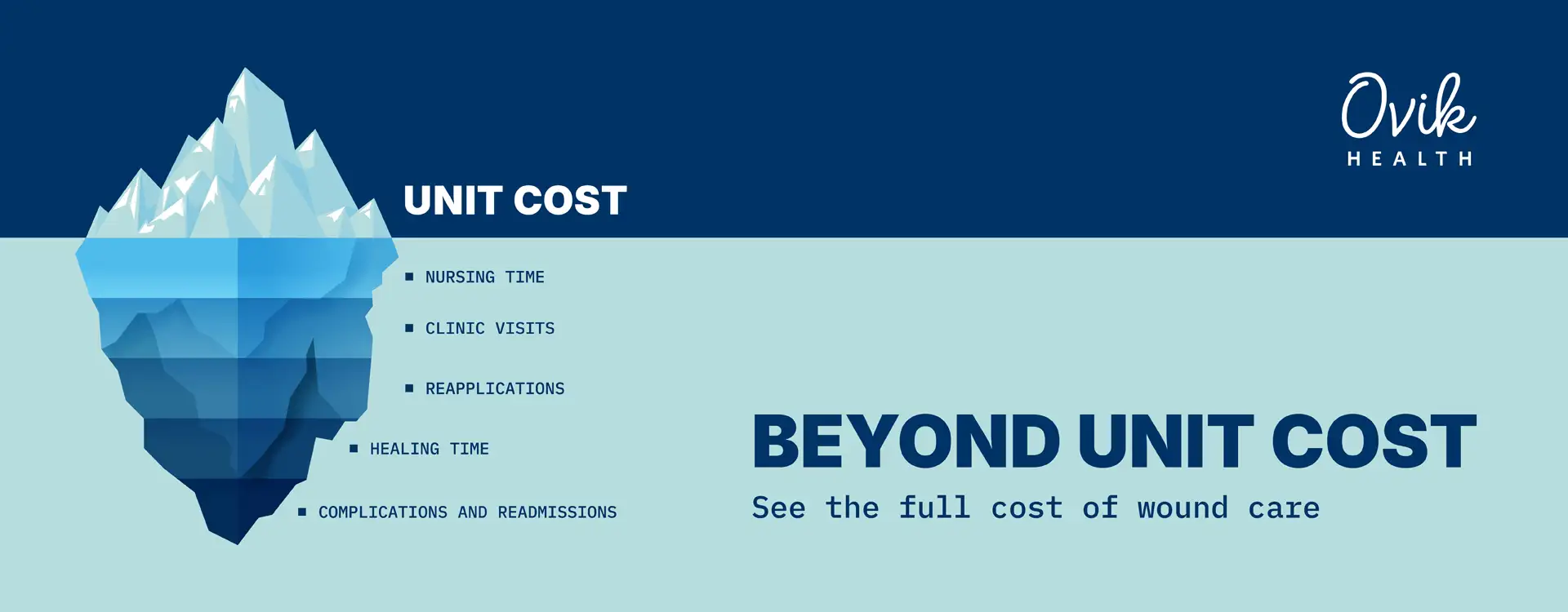
What if the lowest price on your formulary is quietly driving up your total cost of care? For procurement leaders managing wound care supply chains, that question isn’t hypothetical. It’s the gap between what a product costs on the purchase order and what it costs your organization over a full episode of care.
Chronic wounds—especially venous leg ulcers (VLUs)—sit at the intersection of rising clinical demand, tight budgets and complex formulary decisions. This post is for the purchasing and procurement professionals who feel the pressure from both directions: finance wants lower spend, clinicians want better outcomes and patients need care that actually works. Here’s how to reconcile all three by shifting from unit-cost thinking to total-cost-of-care strategy.
The real cost of venous leg ulcers
VLUs are among the most expensive chronic conditions a health system manages, and the burden is climbing. Research on the U.K.’s National Health Service (N.H.S.) estimated that wound care consumes roughly 3% of total health expenditure, with patients who have wounds costing the system up to £5 billion more per year than matched controls. In the U.S., the trend line looks similar: an aging population, more comorbidities like diabetes and a growing volume of hard-to-heal wounds.
Here’s what makes VLUs financially punishing. Up to 15% to 30% of cases don’t respond to first-line treatment and remain unhealed even after six months. Every unhealed wound means more clinic visits, more nursing hours, more dressings and a higher risk of complications and readmission. The cost isn’t in the bandage. It’s in the weeks—sometimes months—of care that follow when healing stalls.
Actionable takeaway: When you evaluate a wound care category, map the full episode of care, not the line item. Ask how each option influences visit frequency, nursing time and healing timelines—because those variables dwarf the unit price.
Why compliance is a procurement issue, not just a clinical one
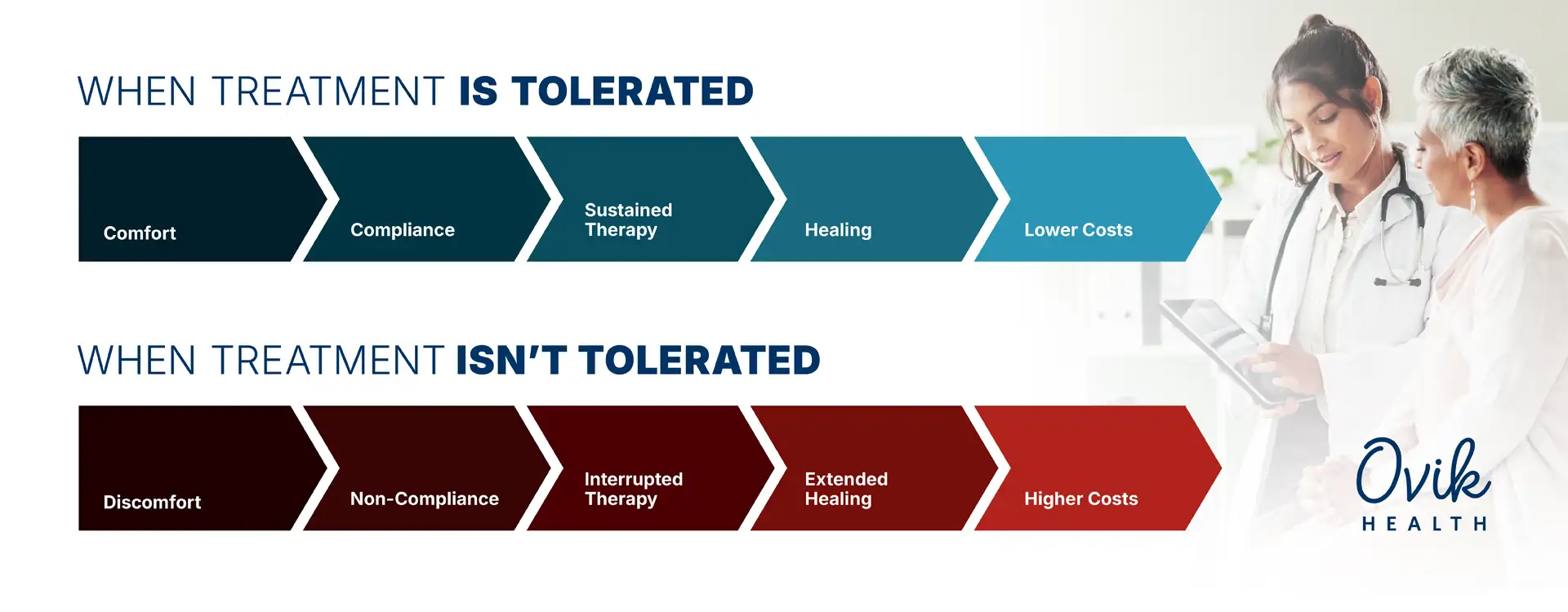
Compression bandaging is the proven mainstay for VLU treatment. The catch? It only works when patients keep it on. Compliance rates in this population are notoriously poor, and discomfort is a leading reason patients abandon therapy. Pruritus alone—itching—develops in as many as one in three patients and drives non-compliance in roughly one in five.
Follow that thread to its financial conclusion. When a patient removes compression early, healing slows or reverses. The episode extends. Costs compound. What began as a comfort problem becomes a spend problem—and it lands squarely in the numbers you’re accountable for.
This is why patient experience belongs in procurement conversations. Products that patients tolerate longer support sustained therapeutic compression, which supports faster healing, which reduces the downstream costs that never show up on a single invoice. Comfort, compliance and cost are one connected system.
Actionable takeaway: Add patient-reported outcomes and comfort data to your evaluation criteria alongside price and clinical equivalence. A product patients wear longer can outperform a cheaper alternative on total cost—even at clinical parity.
Total cost of care vs. unit cost: a smarter evaluation framework
Unit-cost thinking is easy to defend in a budget meeting. It’s also incomplete. Two products can be clinically equivalent—delivering comparable healing rates in head-to-head trials—yet produce very different total costs once you account for reapplication frequency, wear time, nursing labor and complication risk.
Consider a simple reframe:
- Unit cost asks: What does this item cost per order?
- Total cost of care asks: What does treating this condition to resolution cost, and how does this item influence that number?
The second question is where procurement earns strategic influence. When you can show finance that a modestly higher unit price reduces total episode cost—through fewer visits, better compliance or shorter healing times—you turn a purchasing decision into a value decision.
Build a total-cost lens into your process
- Define the episode. Establish the average cost to treat a VLU to healing in your system, including labor and follow-up.
- Identify the cost drivers. Isolate the variables that move that number most: healing time, reapplication frequency, complication and readmission rates.
- Score products against drivers. Weight your evaluation toward the factors with the biggest financial and clinical impact—not just acquisition price.
- Partner with clinical stakeholders. Nurses and vascular specialists see compliance and application challenges firsthand. Their input sharpens your model.
Actionable takeaway: Bring a total-cost-of-care model to your next formulary review. It reframes the conversation from “cheapest option” to “best value,” and it gives clinical and financial stakeholders a shared language.
The formulary decision-making challenge
Formulary decisions are where all of this pressure converges. You’re balancing cost containment, clinical efficacy, supply reliability and clinician preference—often with incomplete data and competing priorities. Standardize too aggressively and you strip clinicians of options patients need. Stay too fragmented and you lose purchasing power and consistency.
A few principles help navigate the tension:
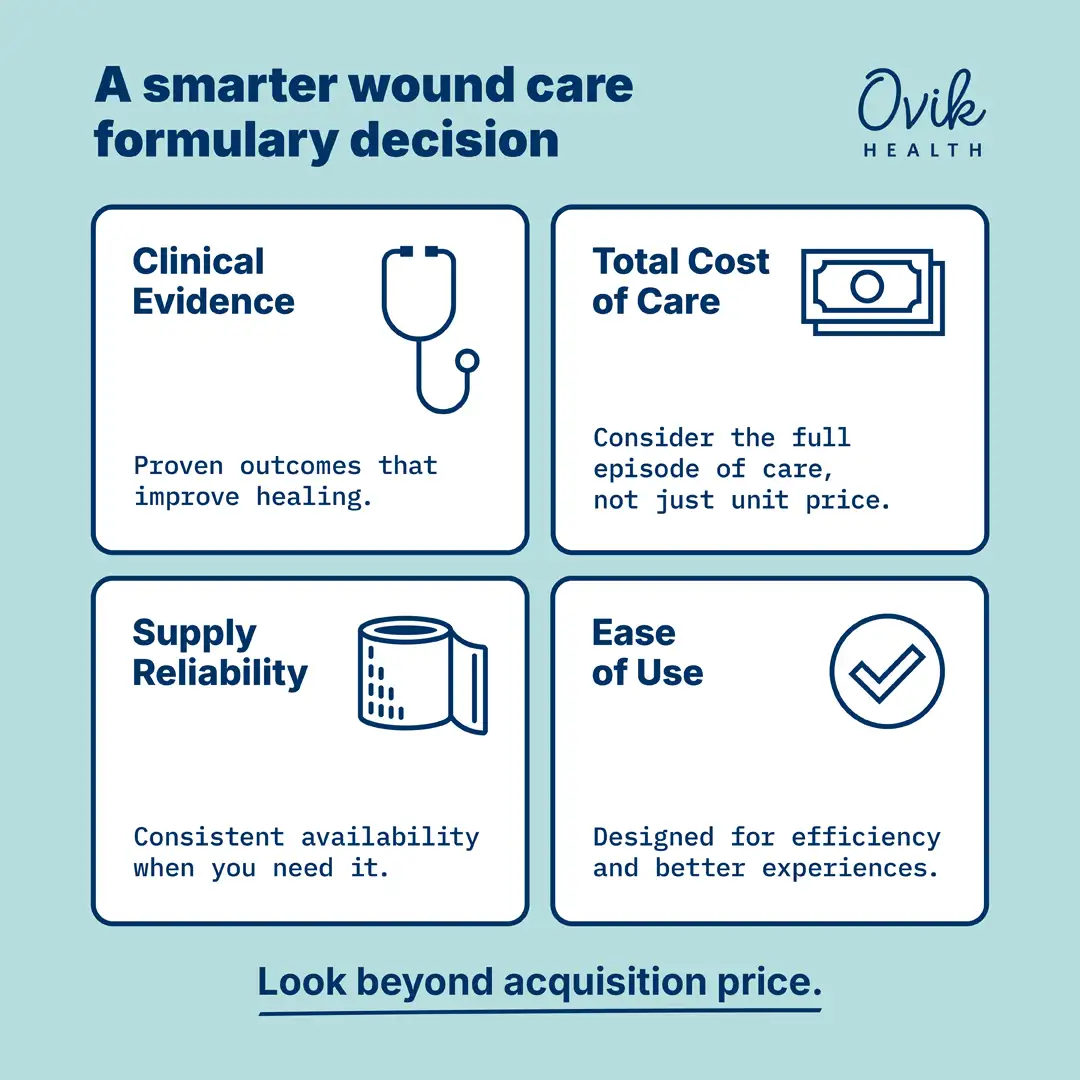
- Anchor decisions in evidence. Peer-reviewed trial data on healing rates and patient preference should carry real weight. Clinical equivalence between options is a green light to compete on value factors like comfort, ease of application and reliability.
- Weight supply chain resilience. A product that’s frequently on backorder carries a hidden cost—clinical disruption, substitution risk and staff time chasing alternatives. Reliability of supply is a legitimate procurement criterion, not a nice-to-have.
- Value ease of use. Products designed for consistent, simple application reduce training burden and application errors—protecting the therapeutic outcome you’re paying for.
- Leave room for clinical judgment. When options are clinically equivalent, letting clinician and patient preference guide selection can improve compliance without adding cost.
Actionable takeaway: Score potential formulary additions across four dimensions—clinical evidence, total cost of care, supply reliability and ease of use—so no single factor dominates a decision that affects all of them.
Common mistakes to avoid
These common procurement mistakes can increase the total cost of care, disrupt treatment and undermine patient outcomes. Here’s how to avoid them:
- Optimizing for unit price alone.
Risk: Labor, clinic visits and complications may account for much more of the real spend.
Better approach: Evaluate products based on total cost of care.
- Treating comfort as a soft metric.
Risk: Discomfort can lead to non-compliance and increased costs.
Better approach: Incorporate patient-reported outcomes into procurement criteria.
- Underweighting supply reliability.
Risk: Stockouts can disrupt care and force costly substitutions.
Better approach: Make supply resilience a scored and documented factor.
- Deciding in a clinical vacuum.
Risk: Procurement and clinical teams may prioritize different outcomes when working in isolation.
Better approach: Build shared evaluation models with clinical stakeholders.
Where procurement leadership makes the difference
The organizations that manage chronic wound care well aren’t just buying smarter—they’re thinking in systems. They see the connection between comfort and compliance, between compliance and healing, between healing and total spend. They treat procurement as a strategic lever for both financial performance and patient outcomes, not a back-office cost center.
That’s the shift worth making. When you move from unit cost to total cost of care, you stop asking “What’s cheapest?” and start asking “What delivers the most value across the entire episode?”—the question that protects your budget and your patients at the same time.
Key takeaways:
- VLU treatment costs live in the episode of care, not the unit price.
- Patient comfort drives compliance, and compliance drives total spend.
- A total-cost-of-care framework reframes purchasing as a value decision.
- Strong formulary strategy balances evidence, cost, supply reliability and ease of use.
Ready to bring a total-cost-of-care lens to your wound care strategy? Explore next-level wound care solutions and see how a smarter approach to chronic wound management can support your outcomes and your budget at contact.ovikhealth.com/next-level-wound-care.