
Description
These instructions are for CoFlex® TLC, CoFlex TLC XL and CoFlex TLC Lite.
CoFlex® TLC and CoFlex TLC XL are standard compression (30-40 mmHg), just different lengths.
CoFlex TLC Lite is lite compression (20-30 mmHg).
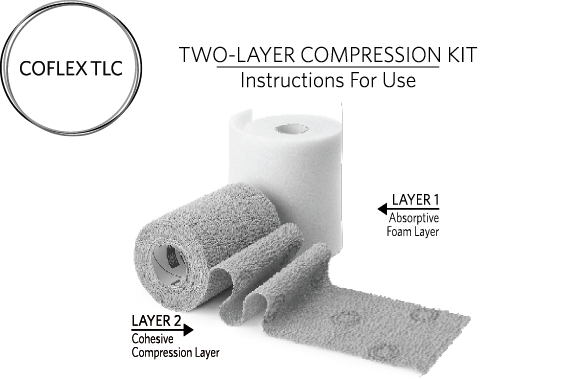
CoFlex TLC, CoFlex TLC XL, and CoFlex TLC Lite are a two-step non-latex compression system. Layer 1 is a foam roll, with odor and itch control properties, that provides comfort and is intended for use over an appropriate primary wound dressing. Layer 2 is a short stretch compression bandage that provides the proper levels of sustained working pressures to promote venous return. This system is designed to work together and provide continuous restorative compression for up to one week. A nylon stocking is included for ease of use and patient comfort.
Indications for Use
CoFlex® TLC and CoFlex TLC XL and CoFlex TLC Lite are designed to treat venous leg ulcers, chronic venous insufficiency, and other edema-related conditions
CoFlex® TLC and CoFlex TLC XL (standard compression) can be used by patients with an Ankle Brachial Index (ABI) greater than or equal to 0.8.
CoFlex® TLC Lite (lite compression) can be used by patients with an ABI greater than or equal to 0.5.
Contraindications
CoFlex® TLC and CoFlex TLC XL (standard compression): cannot be used by patients with an ABI less than 0.8.
CoFlex® TLC Lite (lite compression): cannot be used by patients with an ABI less than 0.5.
Precautions & Warnings
• For compression use only. Incorrect application could lead to severe clinical complications such as tissue damage. To be used under the supervision of a healthcare professional.
• Single use item. If reused, intended restorative compression cannot be assured and increases potential for infection.
• To be used up to 7 days. If used longer than 7 days, intended restorative compression cannot be assured and increases potential for infection.
• Layer 1 of this product contains aloe.
• CoFlex TLC, CoFlex TLC XL, and CoFlex TLC Lite are not made with natural rubber latex.
• CoFlex TLC, CoFlex TLC XL, and CoFlex TLC Lite Layer 1 is not a primary wound dressing. Follow appropriate wound care treatment for the wound condition before applying.
• CoFlex TLC, CoFlex TLC XL, and CoFlex TLC Lite Layer 2 may initially be applied with less tension allowing the patient to adjust to or tolerate the short stretch compression system.
• Wrapping too tightly may impair circulation. Monitor the area of application frequently for signs of pain, numbness, tingling, discoloration, or swelling. If these symptoms occur, remove the product and contact your healthcare professional.
• CoFlex TLC, CoFlex TLC XL, and CoFlex TLC Lite should be changed if it becomes loose fitting, or when it no longer conforms to the shape of the bandaged area. The patient should contact their healthcare professional to determine if it should be replaced.
• CoFlex TLC, CoFlex TLC XL, and CoFlex TLC Lite should be kept dry. Avoid showering, bathing, or swimming unless appropriate waterproof protection is used. If the bandage becomes wet, contact your healthcare professional to determine if it should be
replaced.
• Any serious incident that has occurred in relation to the device should be reported to the manufacturer and the competent authority of the Member State in which the user and/or patient is established.
Layer 2 – Compression Layer:
(1) Begin wrapping Layer 2 on the top of the foot, at the base of the fifth digit in a spiral technique (figure 5).
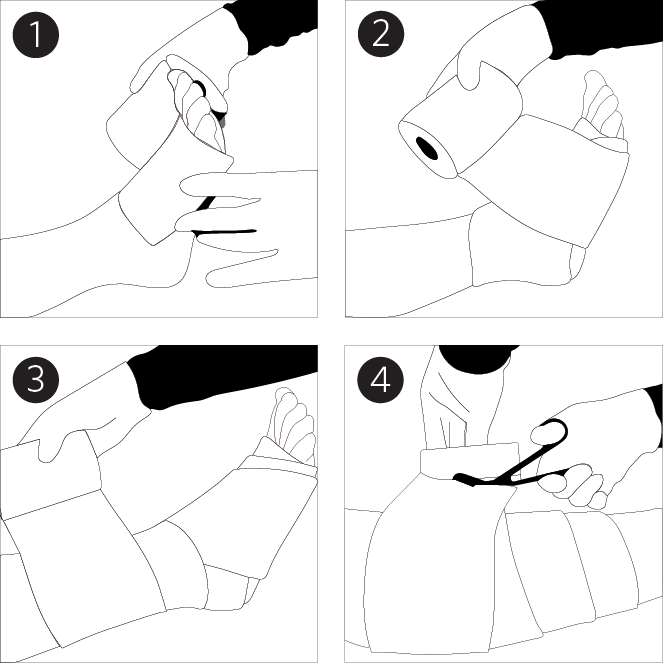
(2) Hold the bandage with thumb and stretch until the ovals become circles. Begin spiral wrapping across the top of the foot, then proceed to wrap two figure of 8’s around the back of the heel/ankle, completely covering the heel and foot. Continue to maintain even tension by stretching the visual indicators from ovals to circles(figure 6). For 2” size, indicators are not included – stretch to the appropriate level.
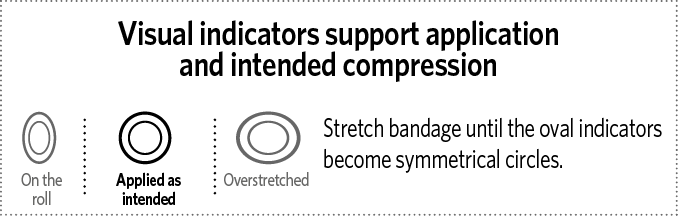
(3) Continue to spiral wrap up the leg, covering Layer 1 with 50% overlap while maintaining even tension (figure 7).
(4) Cut or hand-tear excess material (figure 8).
(5) Gently press over entire application to ensure a strong bond & reduce slippage (figure 9).
(6) Apply the nylon stocking over the system for ease of movement and patient comfort in footwear, under clothes and on bed sheets (figure 10).
Removal/Disposal
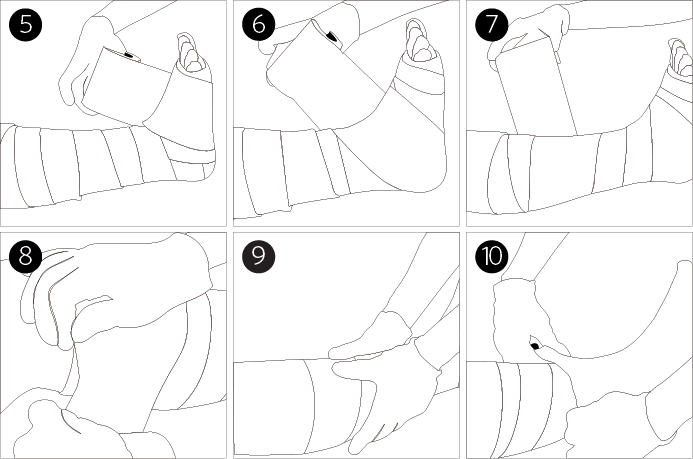
• CoFlex TLC, CoFlex TLC XL, and CoFlex TLC Lite may be removed by unwrapping or with blunt
tip bandage scissors.
If using blunt tip bandage scissors:
• Insert the blunt tip between the wrap and your skin before cutting.
• Cut slowly, using small cuts rather than one long cut.
• Keep the scissors angled away from your skin to help reduce the risk of injury.
• If needed, continue cutting until the wrap can be gently unwrapped and removed.
• Take extra care over bony areas such as the ankle, shin, top of the foot, and behind the knee where the skin is more vulnerable.
• Never force the scissors if you cannot easily slide the blunt tip beneath the wrap.
• DO NOT use sharp household scissors or knives.
• DO NOT pull or tear the wrap off if it is stuck to a dressing or your skin.
• CoFlex TLC, CoFlex TLC XL, and CoFlex TLC Lite may be disposed as normal hospital household waste or according to facility protocol.
Storage
• Store CoFlex TLC, CoFlex TLC XL, and CoFlex TLC Lite in their original packaging at room temperature until use. Avoid excessive heat and humidity.
• Refer to the label on each box for expiration date.